A calm path from decision to finished interior
A good project does not start on the first day of works.
It starts with sequence, responsibility and decisions made at the right moment.
For us, the process is not an add-on. It is the way we lead the entire project.
First the definition. Then the stages.
What process means to us
We do not treat process as a marketing description called consultation, works, handover.
Processs is a model for leading an investment. It is meant to organise the entry into the project, decisions, work sequence, logistics, quality control and the way we respond to constraints before those constraints create cost, delay or quality compromise.
A model for leading the investment
The process is meant to keep order from the input data all the way to handover. Not only in execution, but also in decisions, materials and logistics.
Sequence and dependencies
Every stage has its own inputs and consequences for the next trades. That is why the order of works cannot follow momentary convenience. It has to follow technical logic.
Control points
Quality is not checked only at the end. It has to be checked earlier: during measurement, geometry, surface preparation, built-ins, installations, details and material closures.
Decision clarity
The process must clearly distinguish what is settled, what requires approval, what can still be changed and when a change stops being neutral for the budget, timing or execution.
Consistent standard. Flexible scale of service.
How we adapt the process to the client and project
A process cannot be a rigid template repeated without thought. Control, responsibility and the logic of stages remain constant. What changes is the breadth of scope, reporting level, number of approval points, decision rhythm and scale of coordination. A partial renovation is led differently from turnkey finishing, and differently again from a repeat investment or a project delivered with an architect.
Scope scale
We distinguish between a refresh, partial renovation, full finishing and investment-scale scopes.
Each of these topics requires a different rhythm of preparation, ordering, coordination and control.
Client type
An individual client, architect, real estate agency and developer do not work through the same decision path.
We adjust the reporting method, level of detail and approval model.
Site conditions
An empty property, an occupied apartment, limited building logistics, difficult slants, small rooms or strict delivery windows.
The process has to absorb those conditions, not ignore them.
Level of flexibility
Not everything is scaled. The control standard, stage logic and responsibility remain constant.
What remains flexible is the scope of service, number of options, number of meetings and depth of design support.
This is not theory. This is how we actually lead projects.
How we use the process in practice
The final result is shaped by more than the skills of the teams.
It is also shaped by the way the project is entered, dependencies are mapped, decisions are closed, logistics are set and control is carried out when an error is still inexpensive to catch. This is why the process has an operational form, not a decorative one.
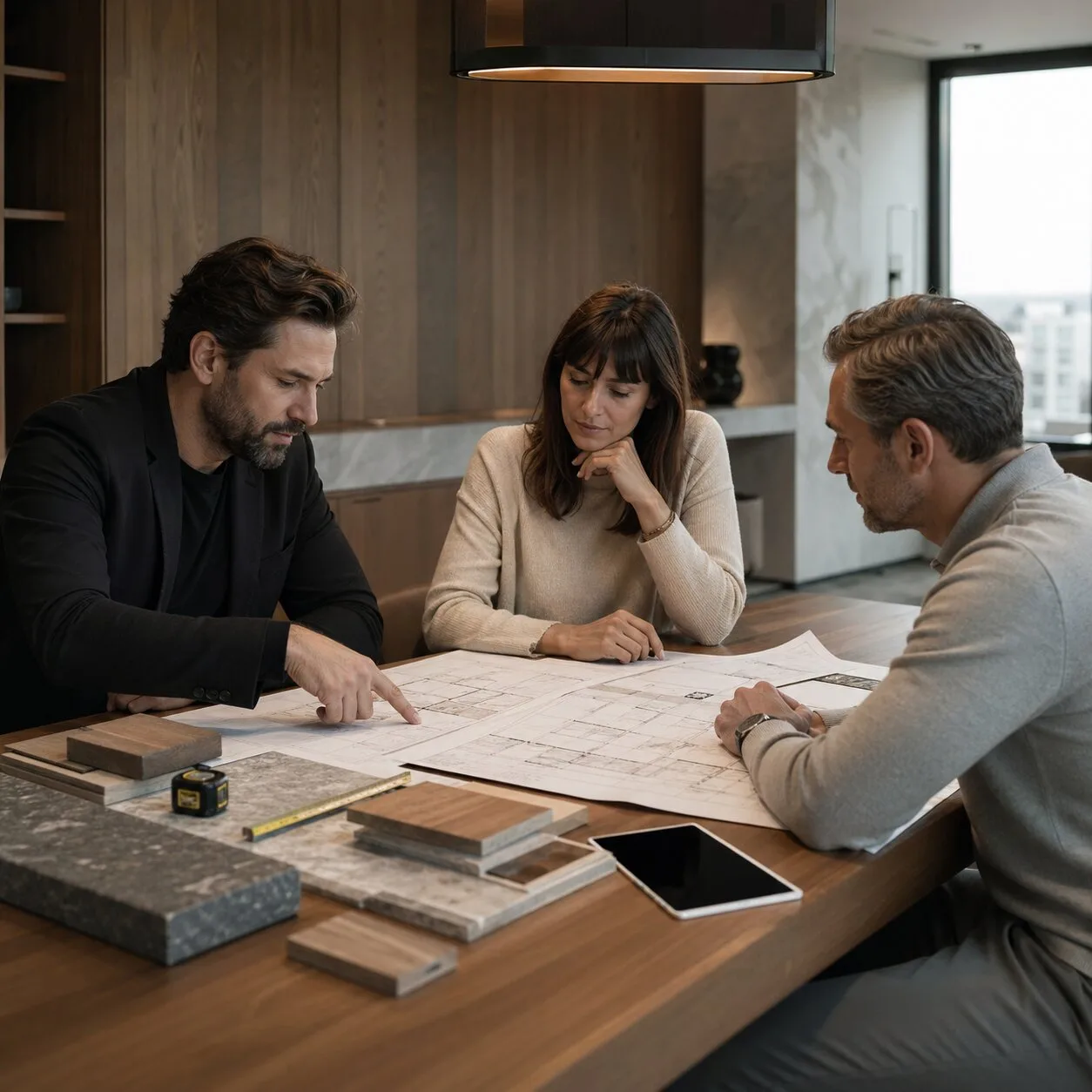
Diagnosis, assumptions, risks
Design and technical entry
We collect input data, the existing condition, constraints, installation dependencies, risk points and critical decisions. We are interested not only in the final vision, but also in everything that could stop the project later.
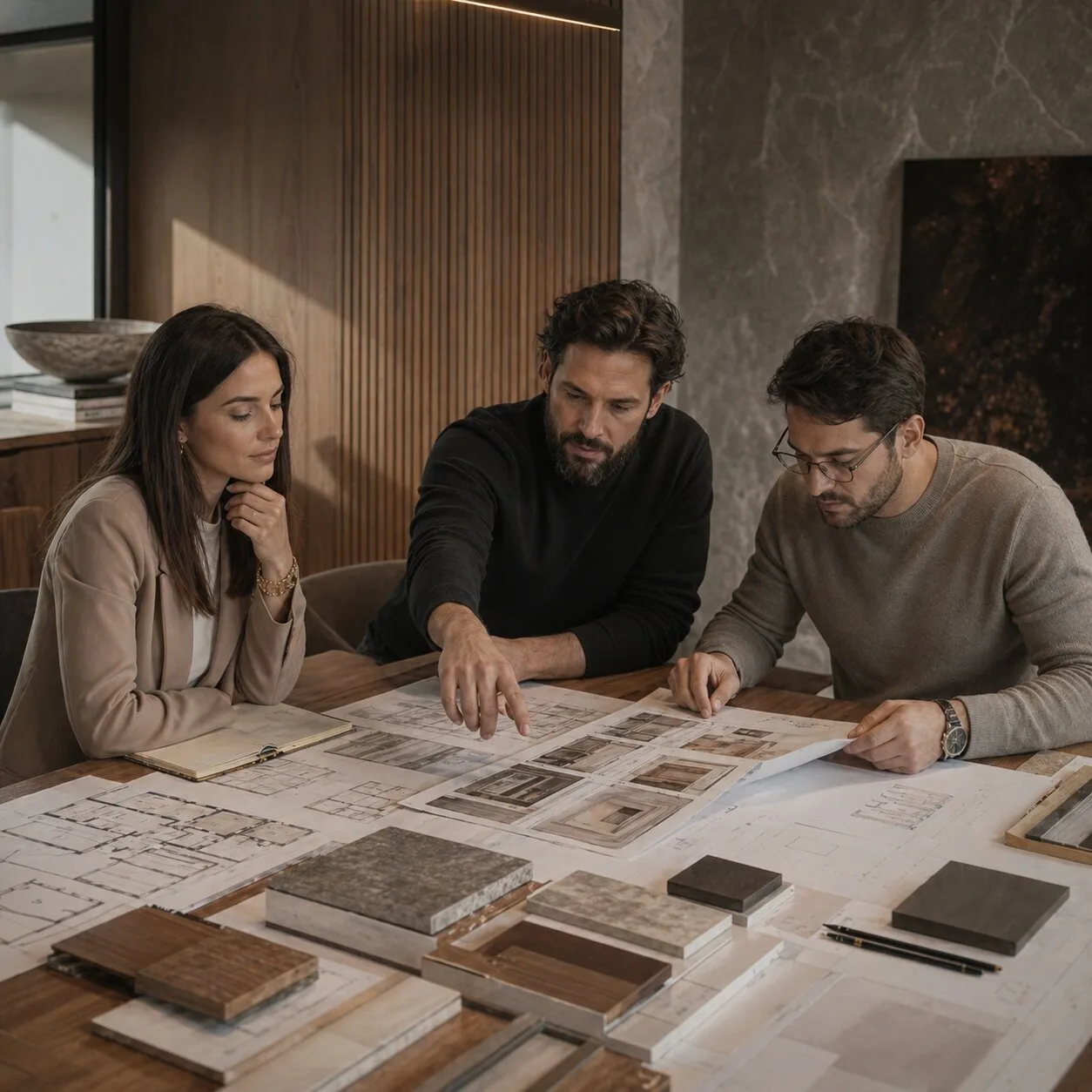
Order, dependencies, decisions
Mapping scope and sequence
We map the logic of stages, responsibilities and decision-closing moments. This makes it clear what has to happen first, where dependencies between trades are and where extra attention is needed.
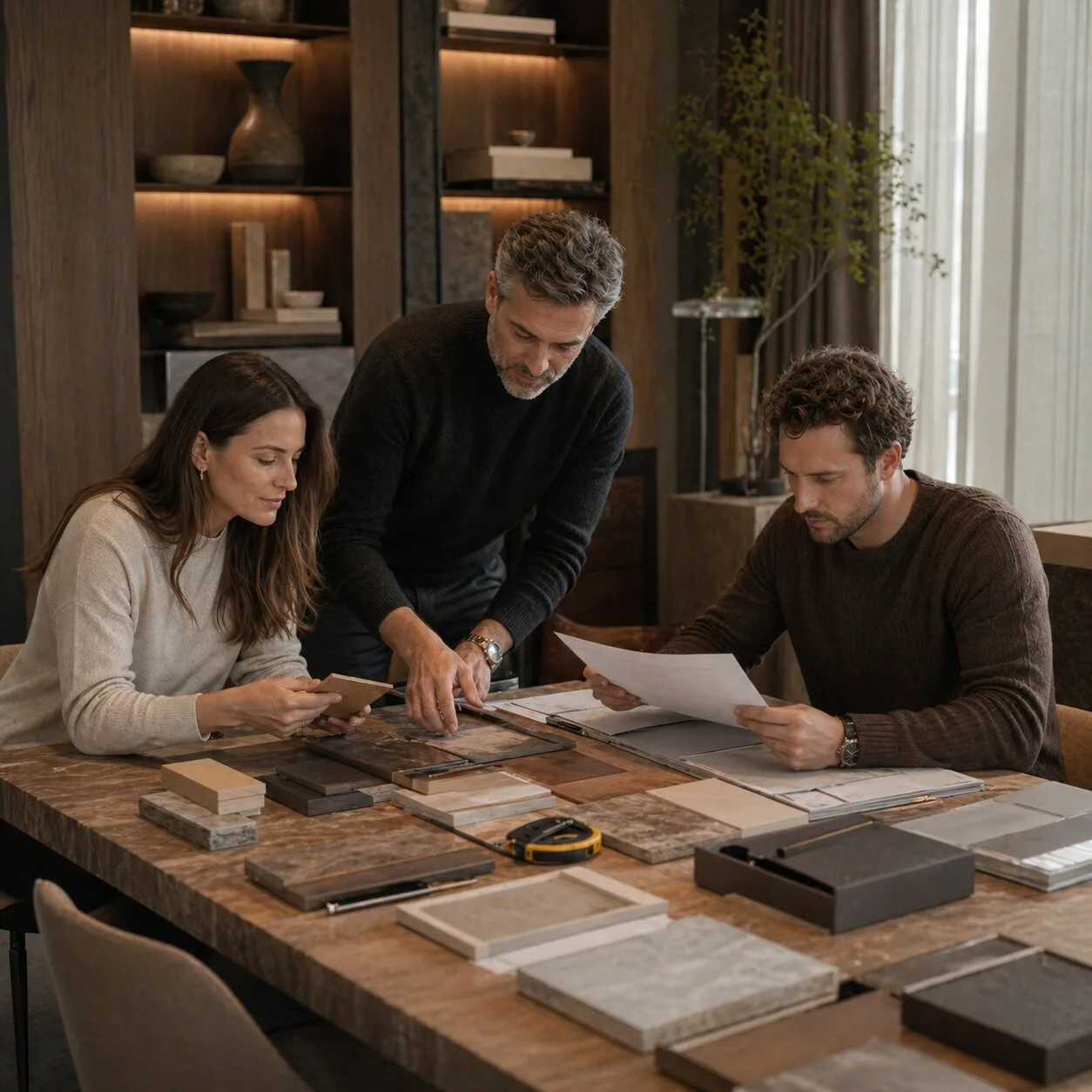
Materials, access, readiness
Execution and logistics preparation
We verify the base, orders, material availability, delivery windows, team access conditions and surface preparation. This stage reduces improvisation and limits unnecessary returns to the same topics.
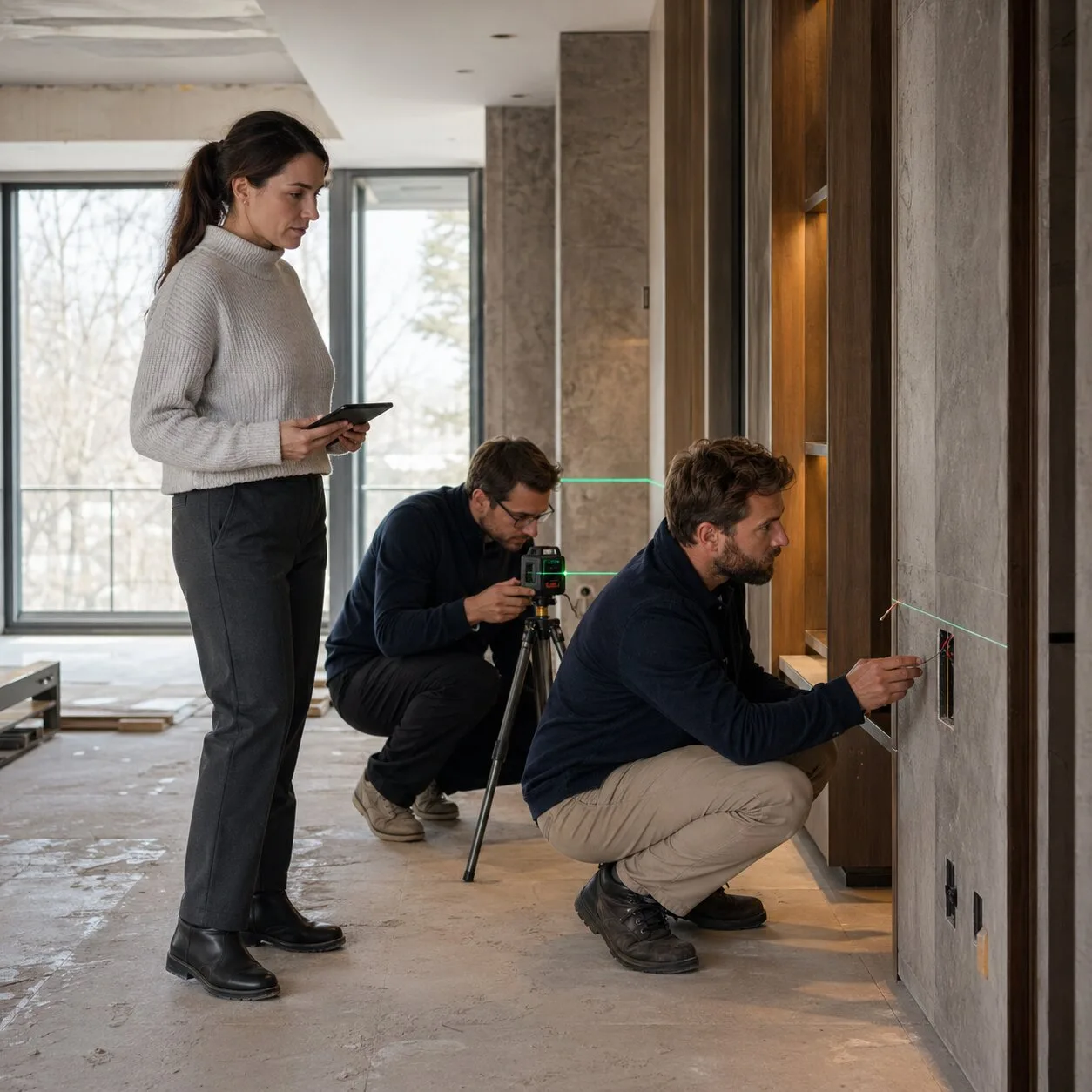
Quality control before closing up
Leading the works through control points
We do not look only at percentage progress. We check consistency with geometry, axes, details, levels, preparation for the next layers and the quality of what is about to be covered. This is where the process really does its work.
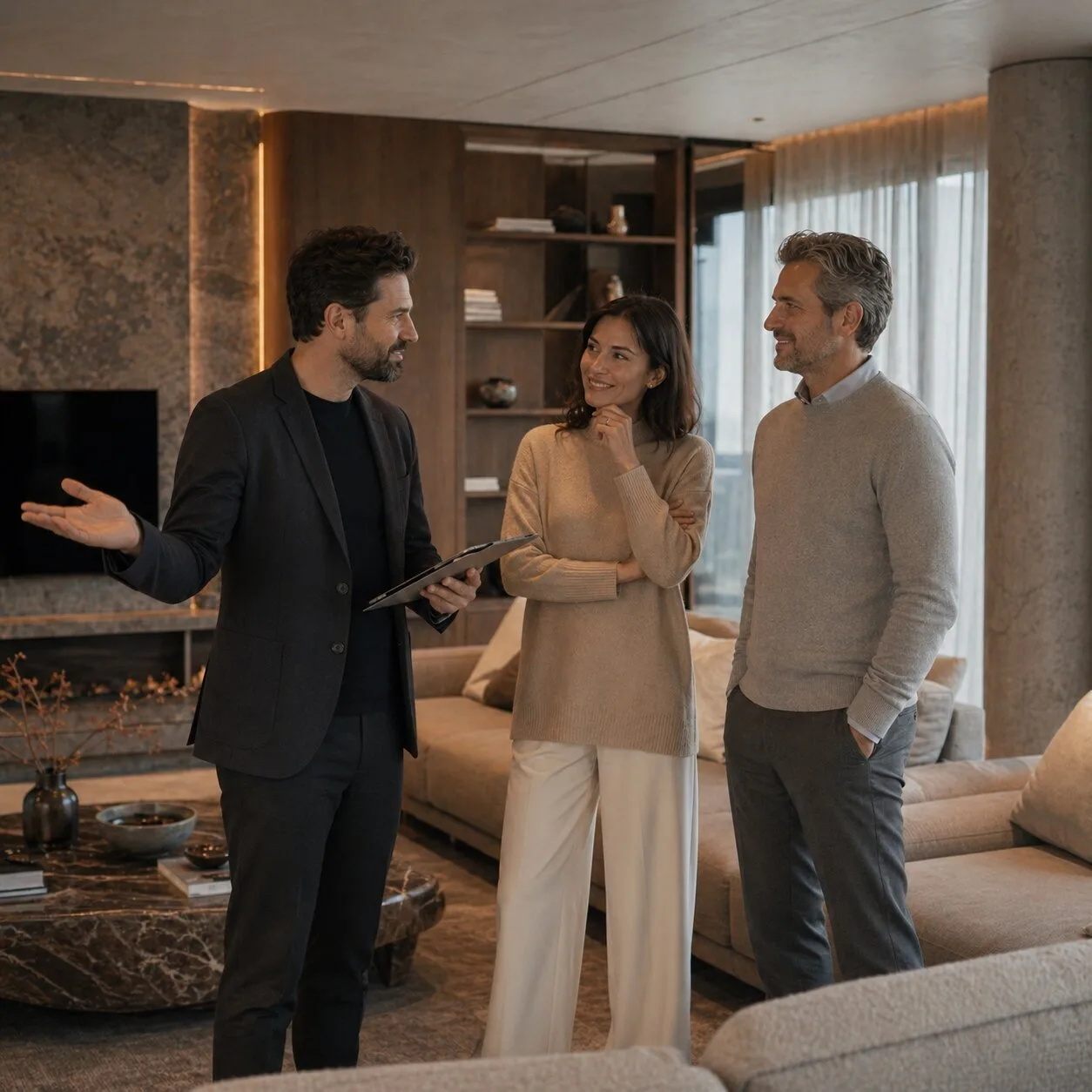
Completeness, handover, calm
Closure, handover and transfer
Handover is not meant to replace the entire control process. It should confirm quality, completeness and readiness for use. The final stage should close the topic, not rescue what no one controlled earlier.
The process should fit the investment, not the other way around.
If you want to discuss a project technically, practically and without pretending that every topic can be led by one template, let us start with the real starting conditions.
It may be a single apartment, a difficult remodelling, finishing for a private client, a project with an architect or a cooperation model for a larger number of units.
A well-set process does not slow an investment down. It reduces chaos, errors and decisions made too late.
Processs in practice, from a heavy layout to calm elegance
Bathroom under sloped ceilings
Sometimes the biggest change does not begin with choosing tiles.
It begins with looking again at a space that for years was difficult, heavy and not very intuitive. In this bathroom, the point was more than a refresh. It was about restoring lightness, function and beautiful order under a demanding sloped ceiling.
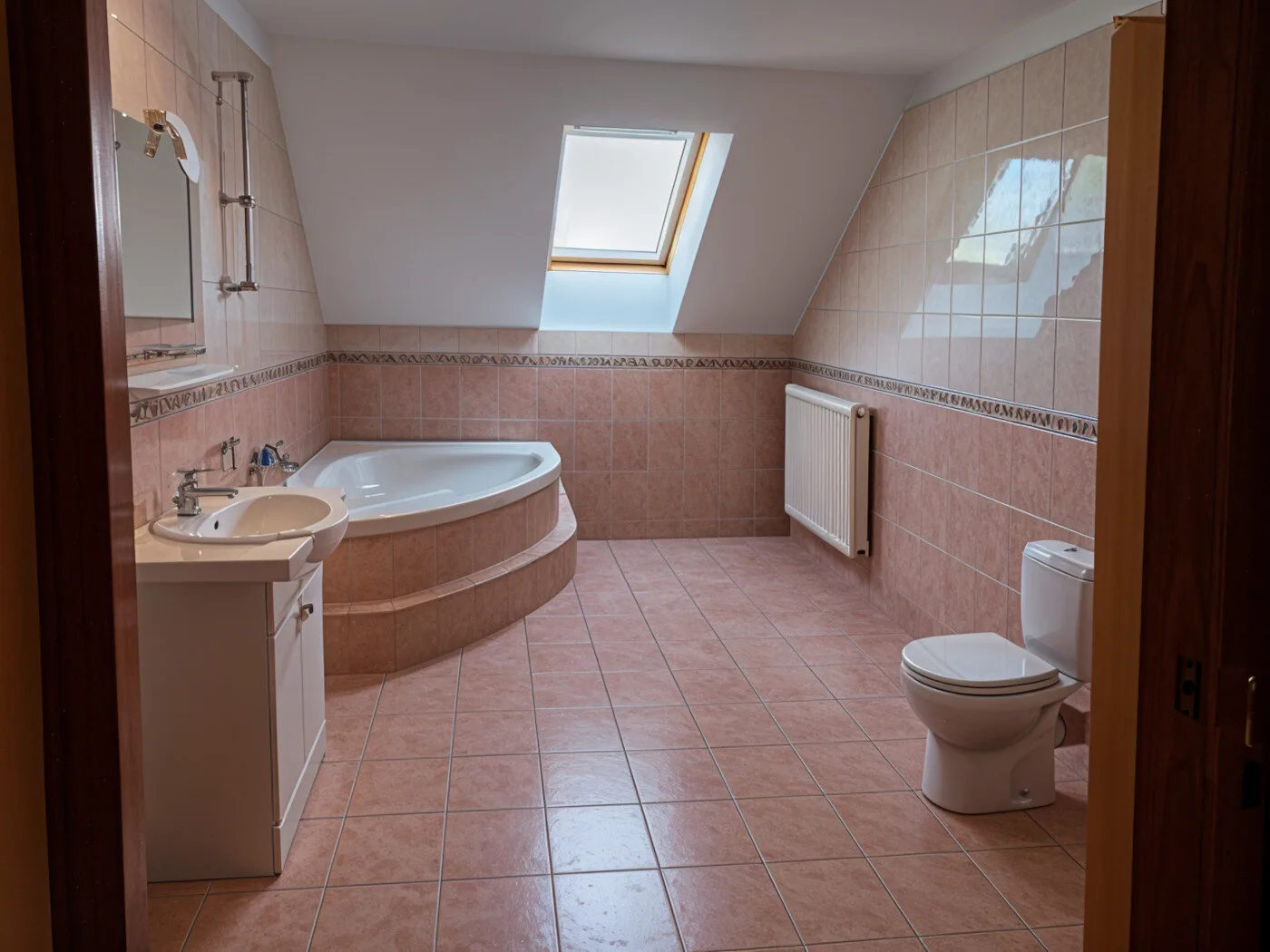
Old layout under the slope
The starting point was a bathroom with a large corner bathtub, a radiator on the right wall, a toilet by the entrance and very outdated tiles. The space had potential, but the slants, old functional division and heavy bathtub surround took away its lightness and limited better use of the area.
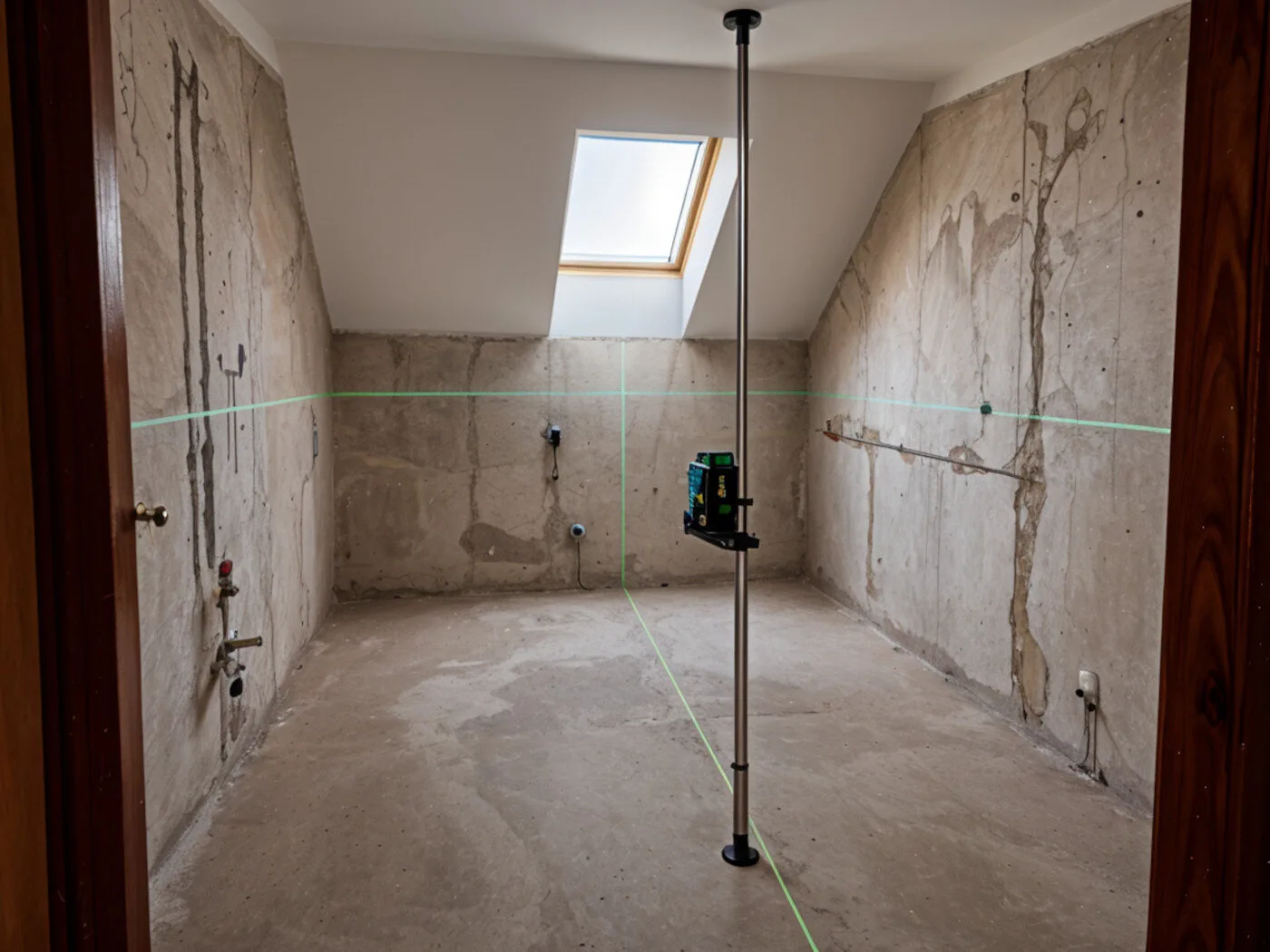
Demolition to a clean base
The old bathtub, ceramics, radiator, tiles and limiting layout are removed from the room. Only raw walls, exposed connections and the construction laser show the true geometry of the interior. This is the moment to check levels, axes and realistically plan a new functional division.
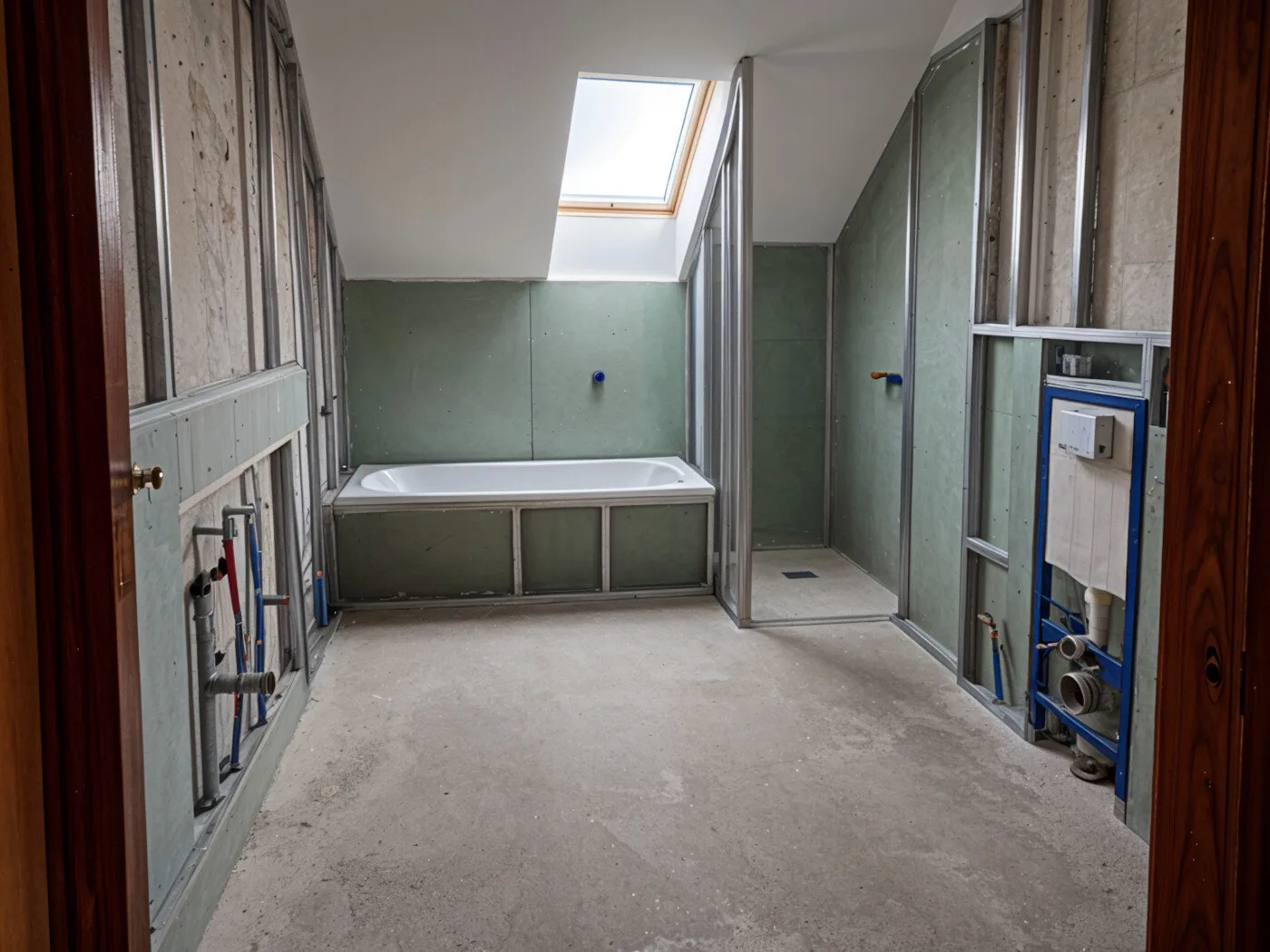
New layout in construction
Here the real functional change is already visible. Instead of the old corner bathtub, a rectangular tub appears under the slope, a shower zone is created on the right, the washbasin is prepared near the entrance and the WC frame moves into a new built-in structure. Profiles, boards and installations show that we are not recreating the old scheme, but building a new bathroom logic.
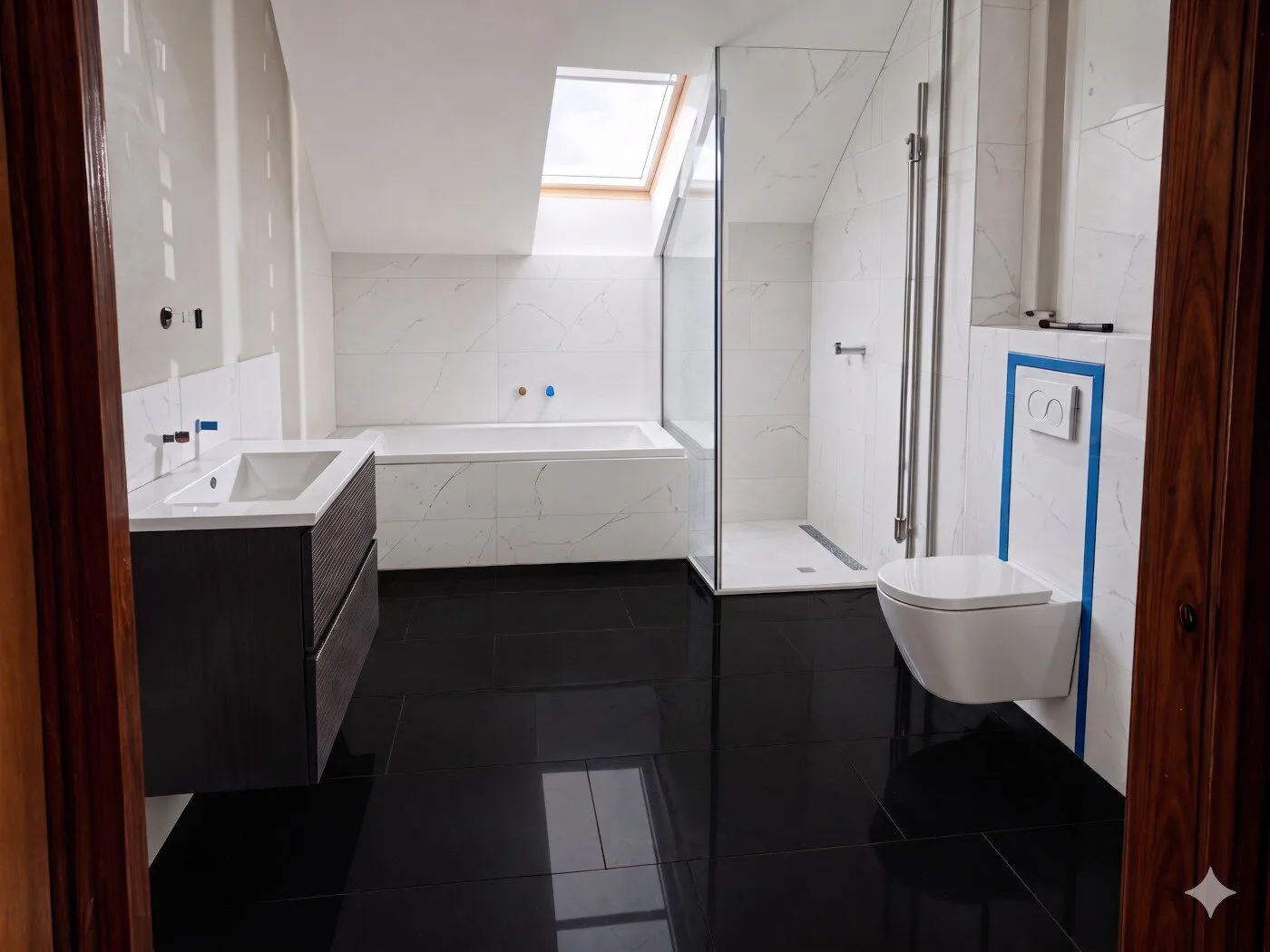
Functions move into place
At this stage the new layout is already clear: the bathtub sits on the slope axis, the shower changes from a heavier build into a lighter glass zone, and the WC and washbasin are set in their target locations. You can also see connection adjustments above the bathtub and the first tile closures. It is not the final result yet, but the moment to check whether the new proportions and transitions really work.
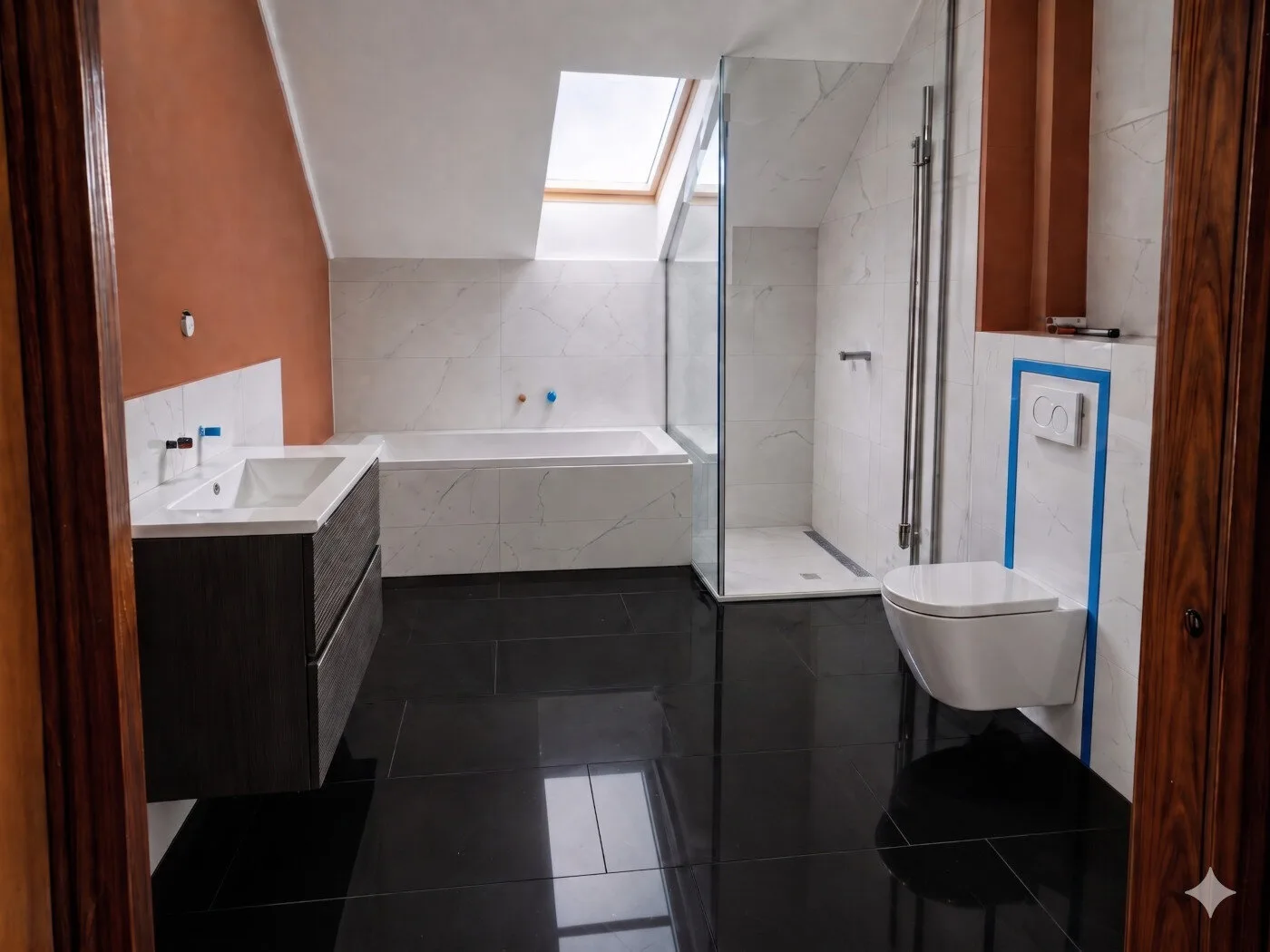
Closing walls, ceilings and colour
After the main elements are set, it is time for the surfaces that build the character of the interior. Ceilings and slopes are finished cleanly, and the walls without tiles receive a warm brick-copper colour. This is the stage where the site begins to calm down: less raw structure, more order, clean cut-offs, corners and control over how tile, colour and white start working together.
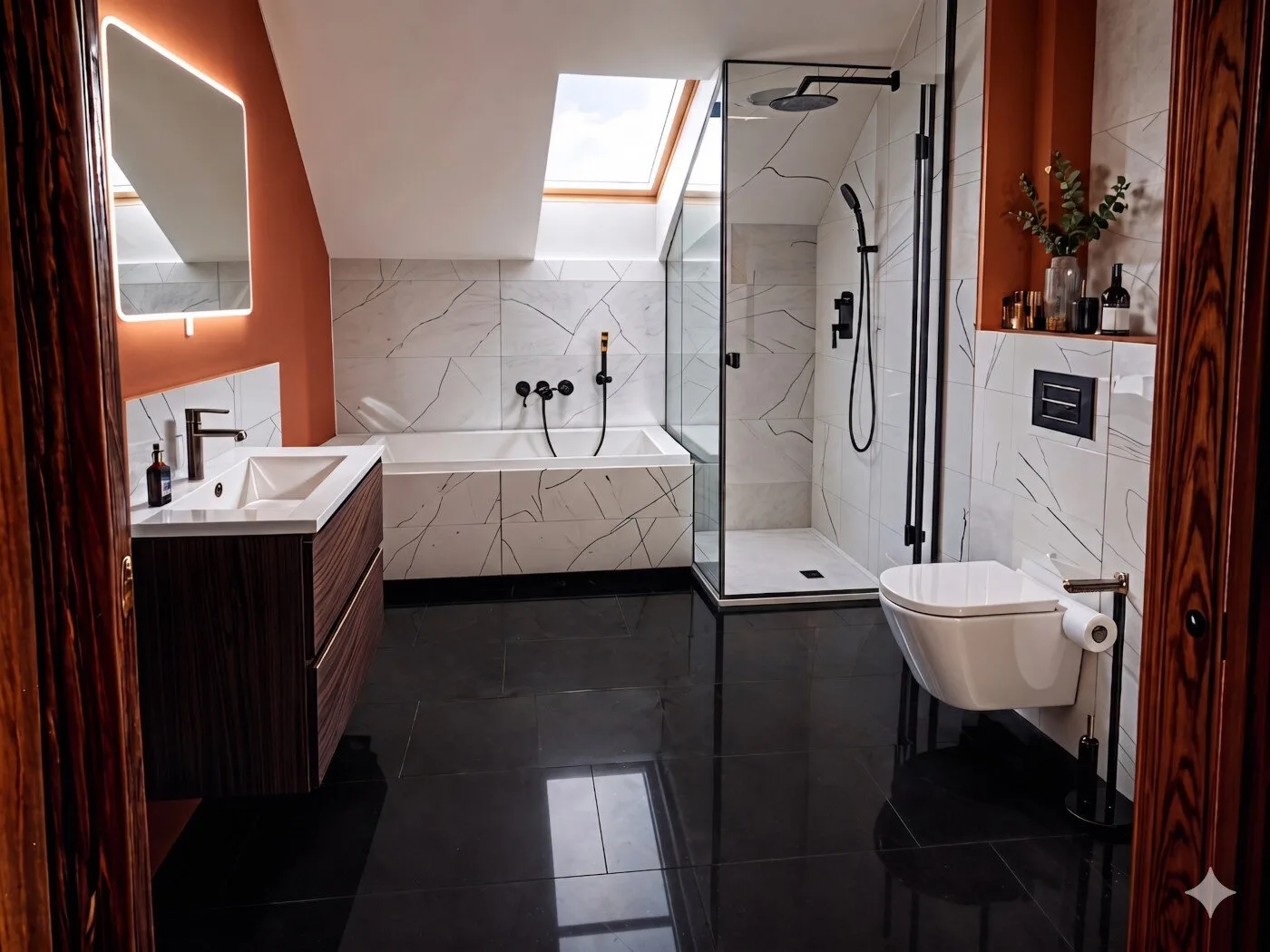
Final installation and finishing adjustments
At the end, tapes, tools and temporary elements disappear, and full equipment appears: fittings, LED mirror, shower doors, WC accessories and details on the built-in structure. Some decisions are still refined compared with the earlier stage, but the layout remains the same. The final result shows not only the effect, but also how much depended on well-led stages underneath.
Processs in practice, one wall, a real child’s room and responsibility for every stage
A child’s room during normal family life
At first glance it may look like a small change: one wall, a few electrical points, colour and finishing.
In practice, it was work in a room used by a child every day for play, rest, storage and the ordinary rhythm of home life. That is why accuracy mattered, but so did pace, cleanliness, safety and keeping the process as unintrusive as possible for the household.
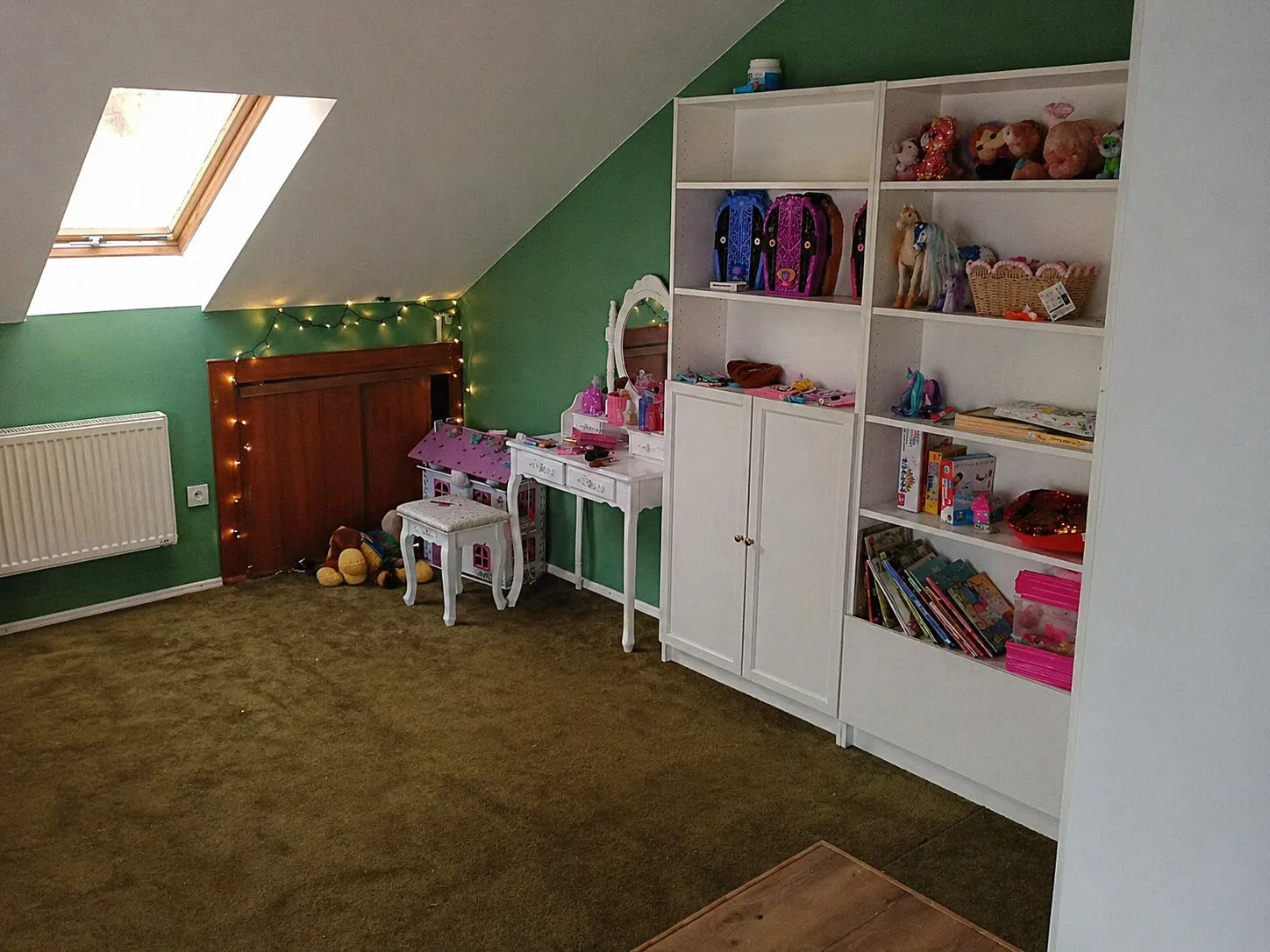
A room before the change, but not before life
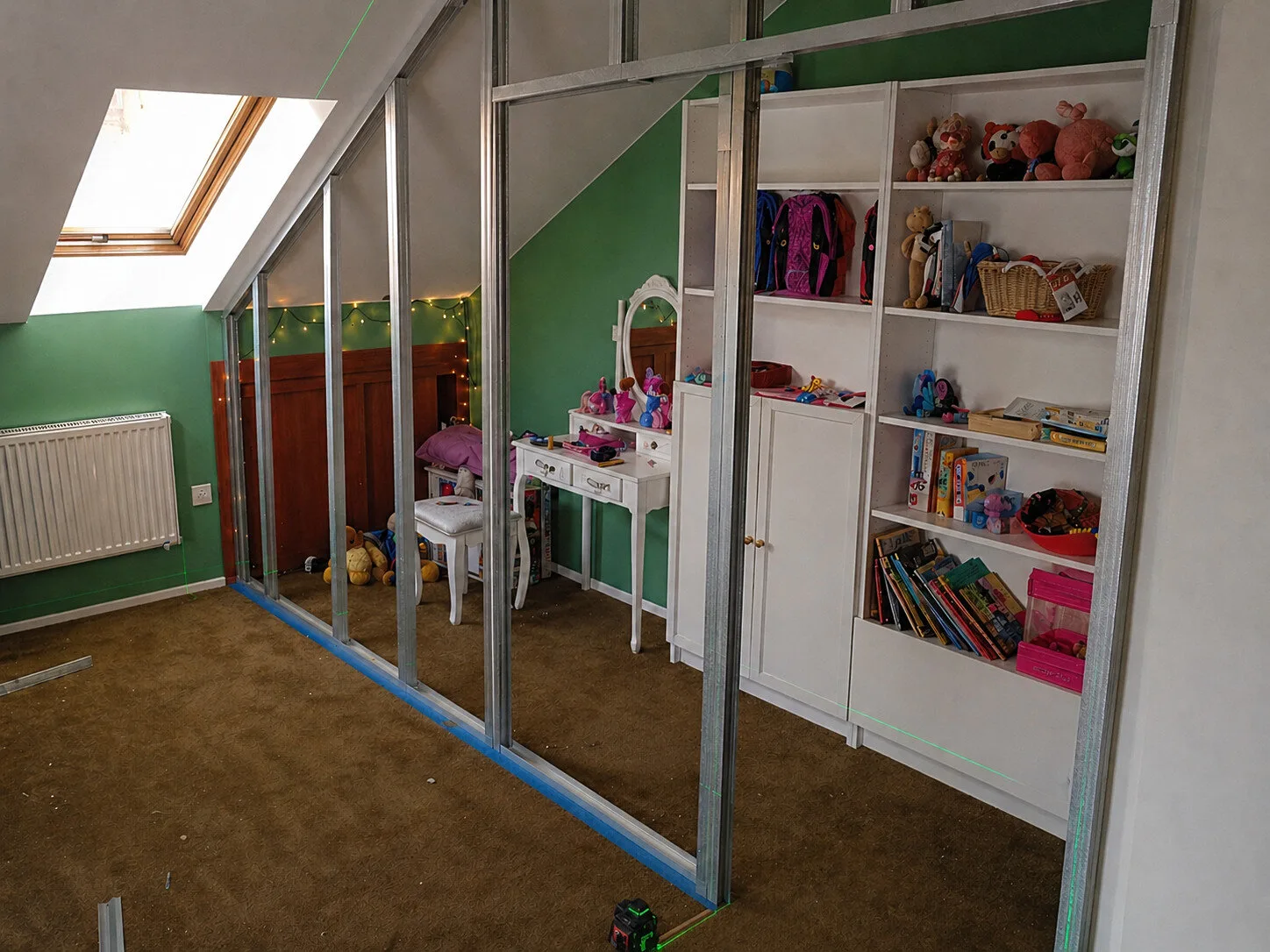
The starting point was not an empty room prepared for a convenient renovation. It was a normally used child’s room with furniture, books, toys, clothes and everyday movement around the home. That is why from the beginning we had to think not only about the wall itself, but also about how to carry out the works quickly, cleanly and without disrupting the whole room longer than necessary.
Structure set out in an active room
The first stage was setting out the structure for the new wall. The profiles were aligned on axis, with control of verticals, lines and the future opening. From the outside this may look technical and simple, but in a room like this it matters a lot. We work among existing furniture and a child’s belongings, so every movement has to be planned to limit the risk of damage, mess and unnecessary chaos.
Closing the wall and routing the electrical points
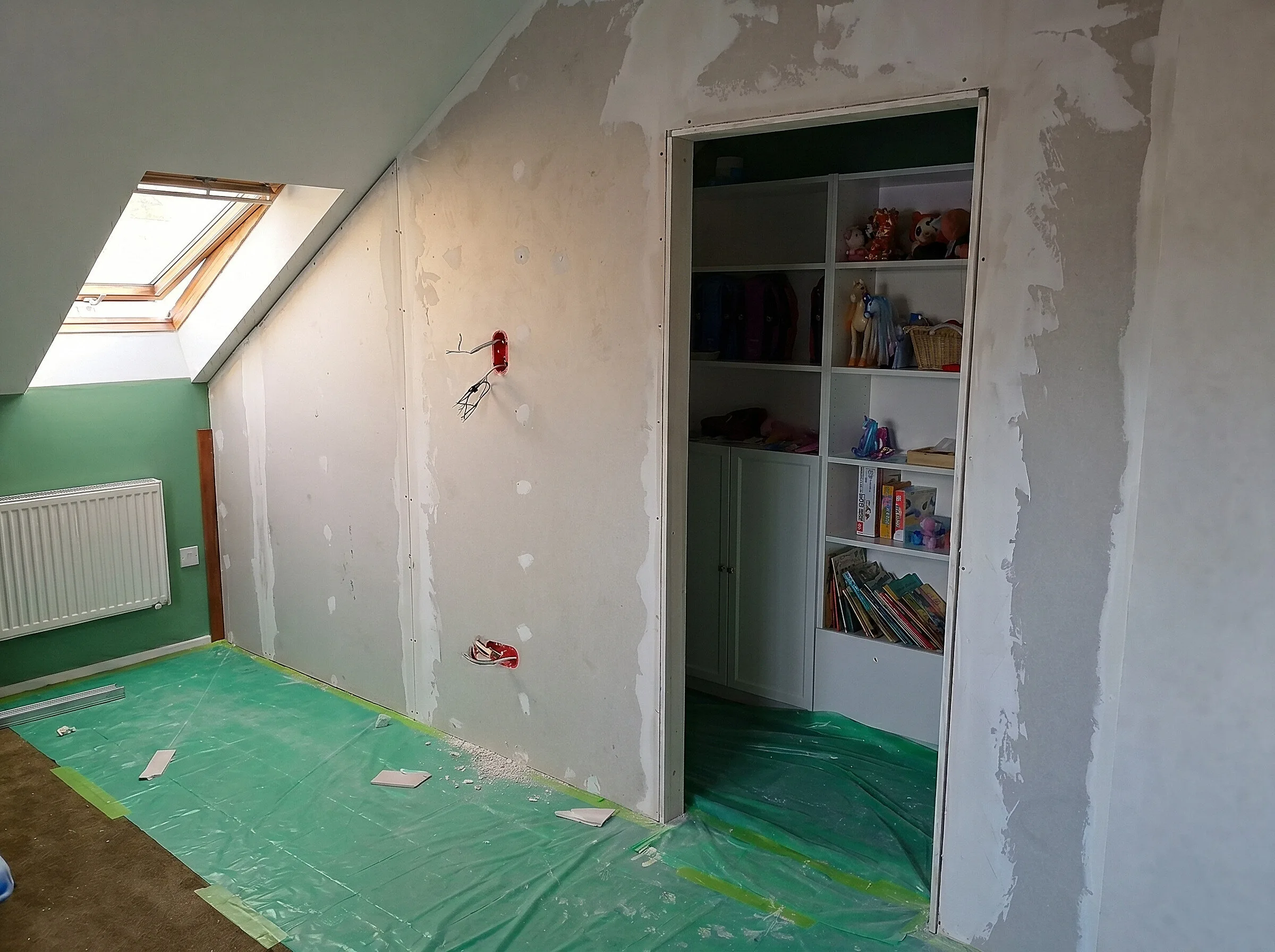
After the structure came plasterboard closing and preparation of electrical points for later use. The target division is already visible: the main wall from the room side and the passage to the shelving area. The floor is protected, because in a child’s room order is not an extra. It is part of the safety and comfort of the household during the works.
Skim coat, surfaces and preparation for colour
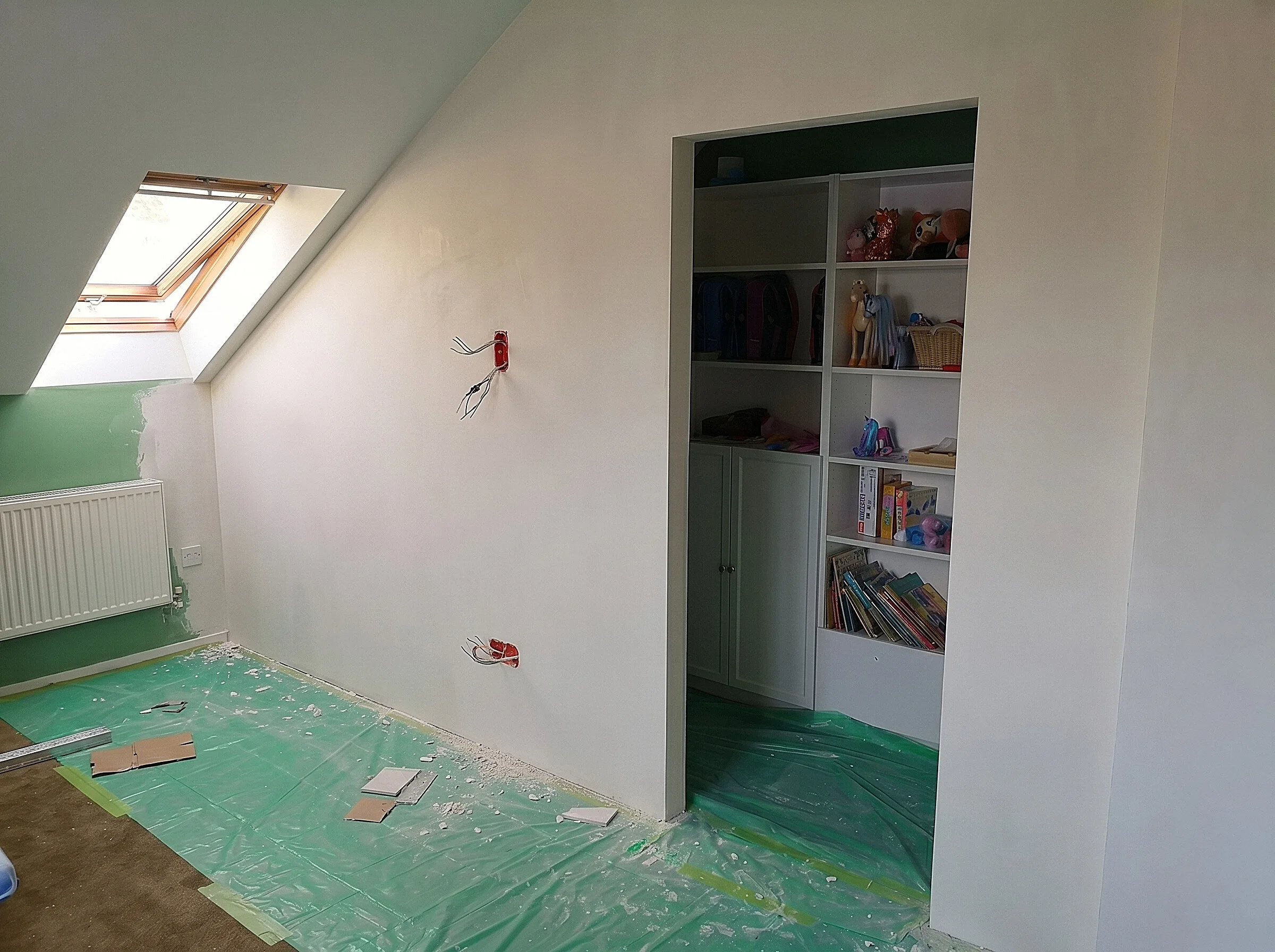
At this stage the wall stops being a structure and starts becoming a natural part of the room. The skim coat cleans up board joints, screw points, corners and the area between the new built-in element and the existing space by the window. It is a stage that is almost invisible later, but it decides whether the finished wall looks calm, even and like something planned here from the beginning.
Colour integrated into the existing interior
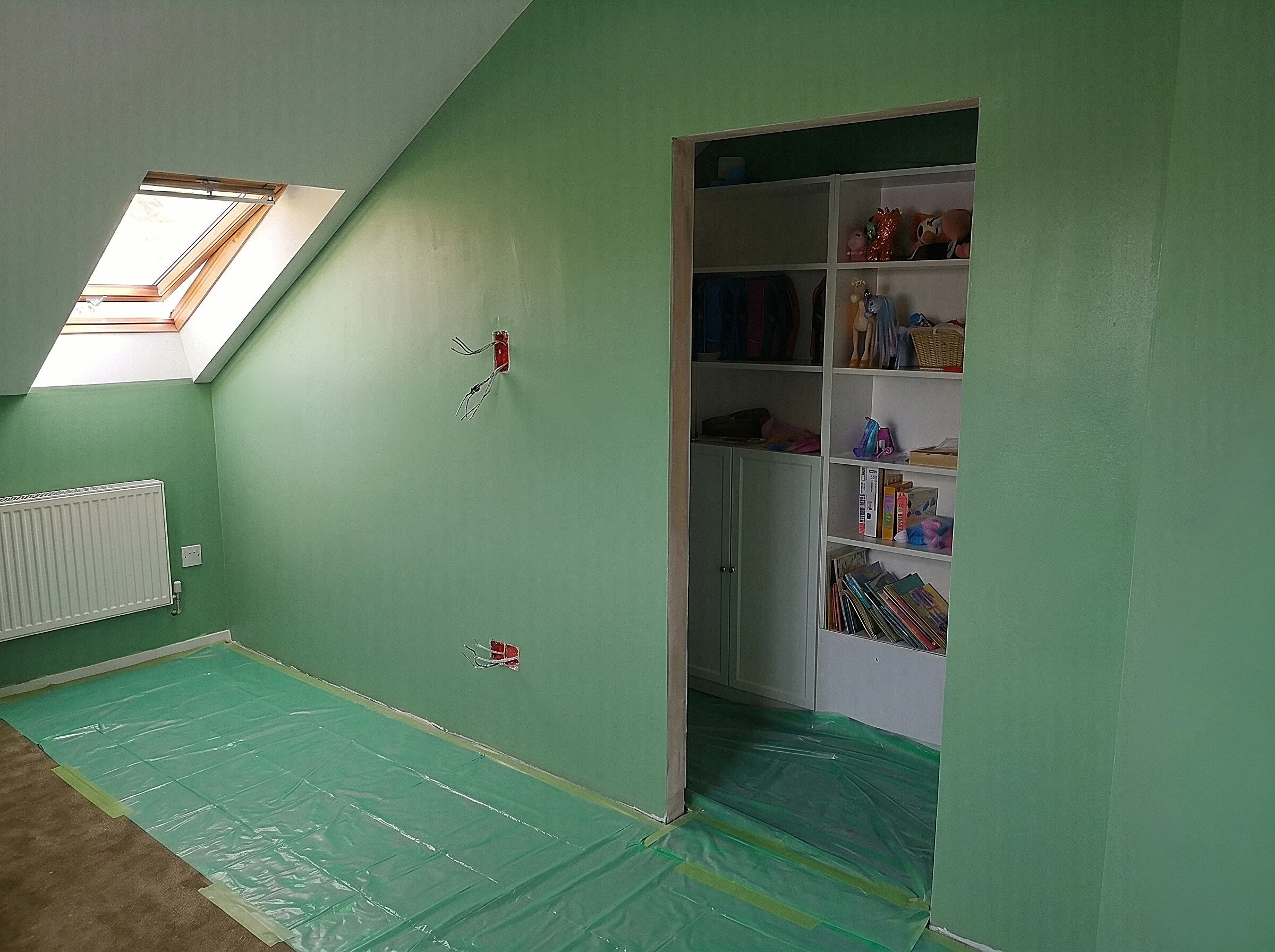
After surface preparation, the wall was painted in a colour consistent with the rest of the room. Thanks to that, the new element does not look like a random addition, but like part of the existing interior. The ceiling remains white, the slopes keep their lightness, and the green surface organises the whole space and prepares it for final installation of sockets, switches, skirting, trim and the TV.
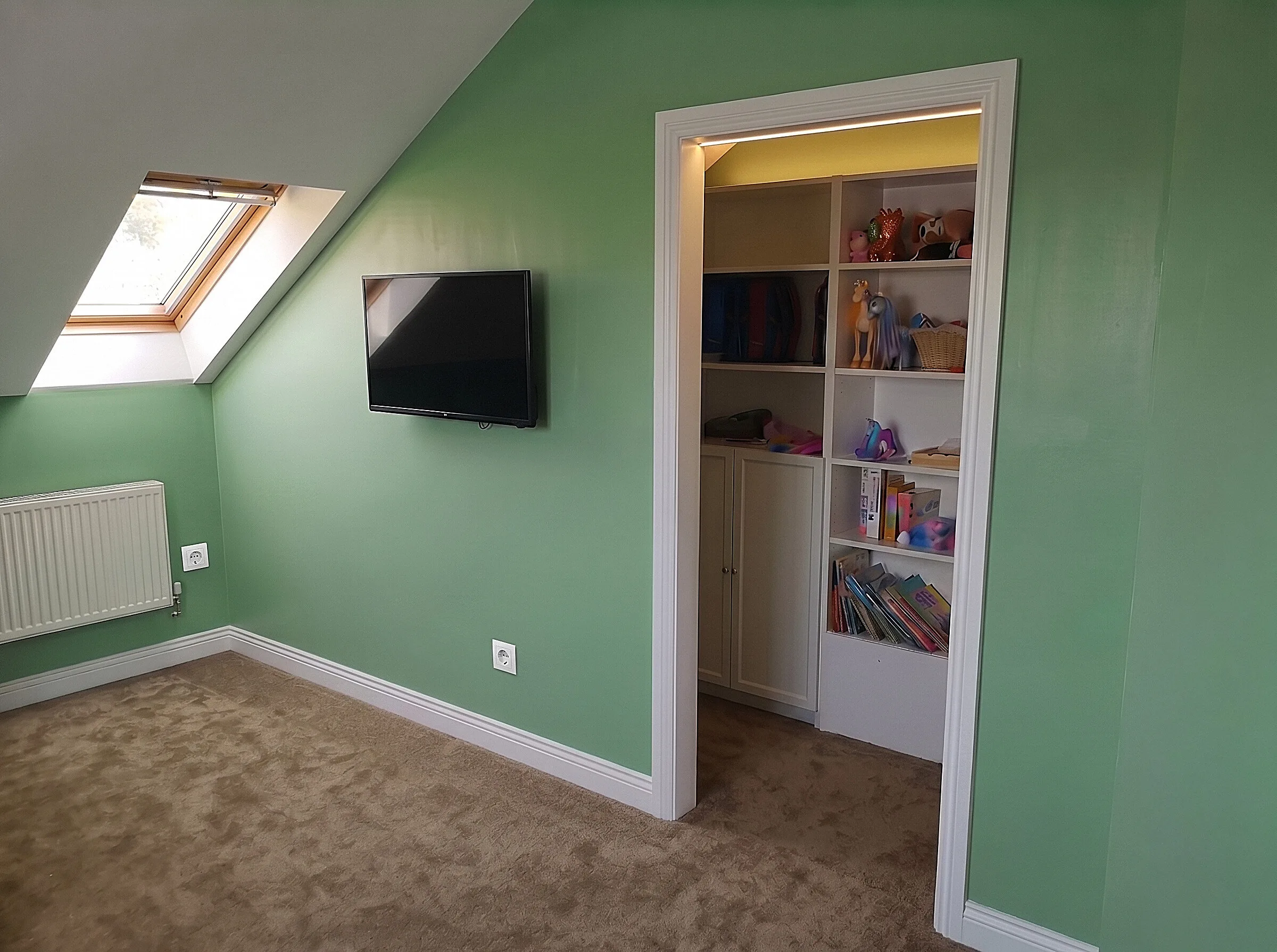
Finished room and a safe return to everyday life
The final result is not just a finished wall. It is a mounted TV, electrical fittings, white skirting boards, a finished passage and an organised space that the child can return to without feeling the room is still a building site. This project shows well that even a seemingly small scope requires responsibility, especially when we work in a child’s room in a normally functioning home.
From a raw base to a wall that gave the interior character
RTV built-in and media wall
Not every project begins with a full renovation of the whole interior.
Sometimes the most important change focuses on one wall that has to connect technology, proportion, light and everyday comfort. In this example, the process leads from a clean base, through structure and built-in work, to a refined effect with lighting, material and final living room arrangement.
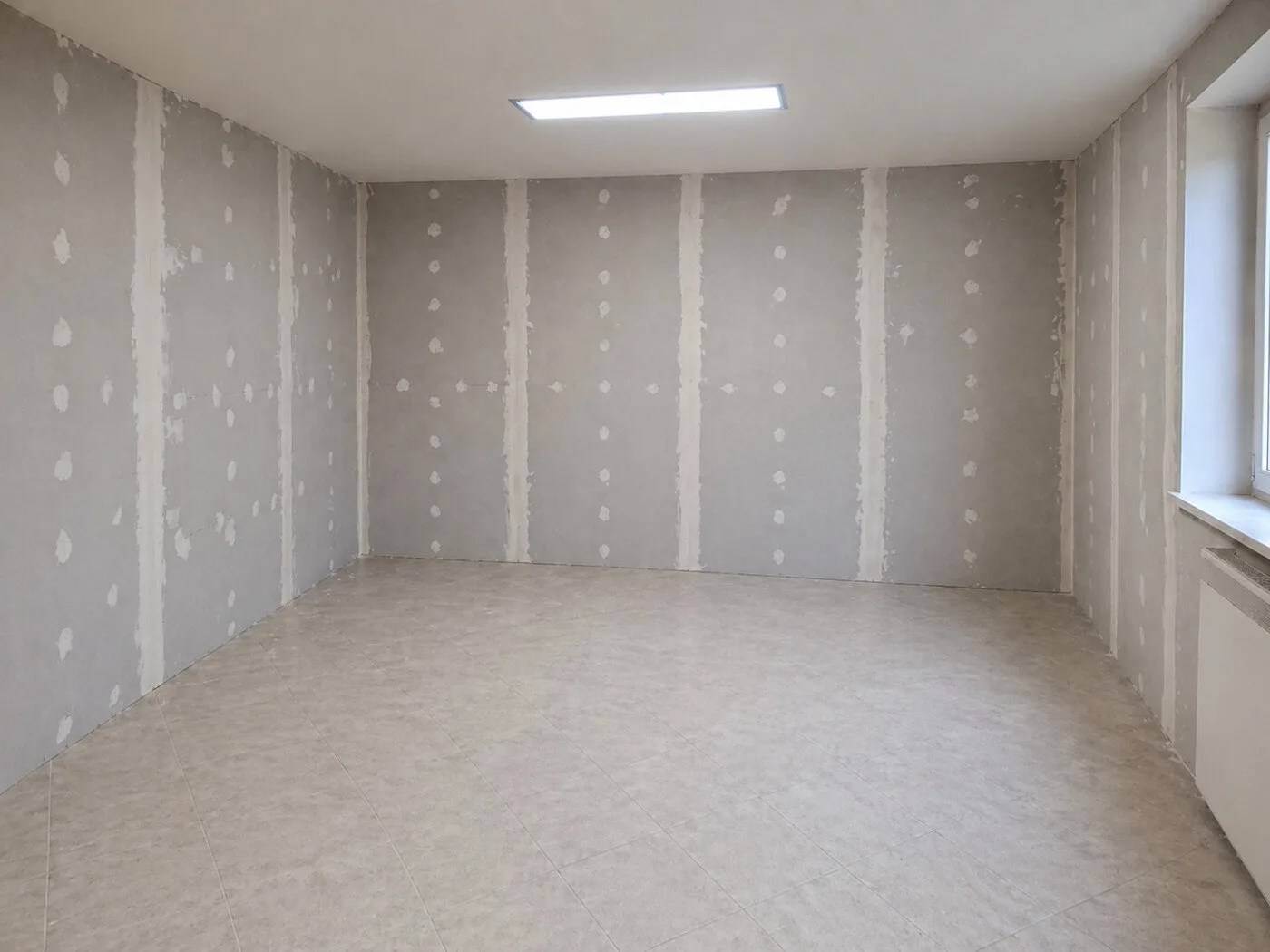
Raw room base
The starting point was a clean, raw interior after wall preparation. No decoration, no clear axis and no element organising the space visually. This is an important stage, because this is where the scale of the room and the potential of the wall that would become the centre of the living room are easiest to see.
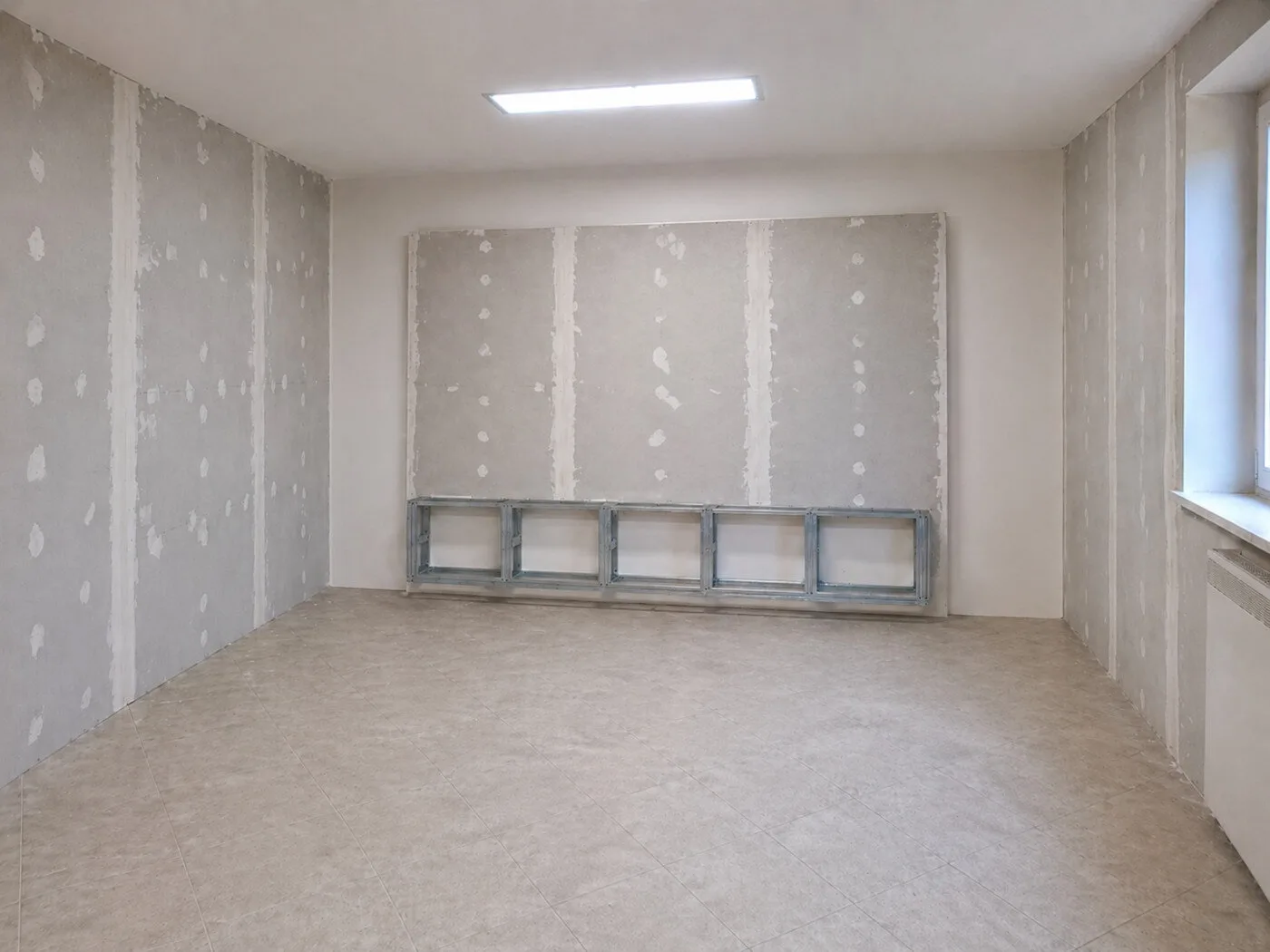
Setting out the built-in area
At this stage the first clear division of the composition appears. The central part of the wall is marked for the future RTV built-in, and the lower structure for a horizontal volume is created. This is the moment when an empty room begins to have an axis, proportions and direction for further works.
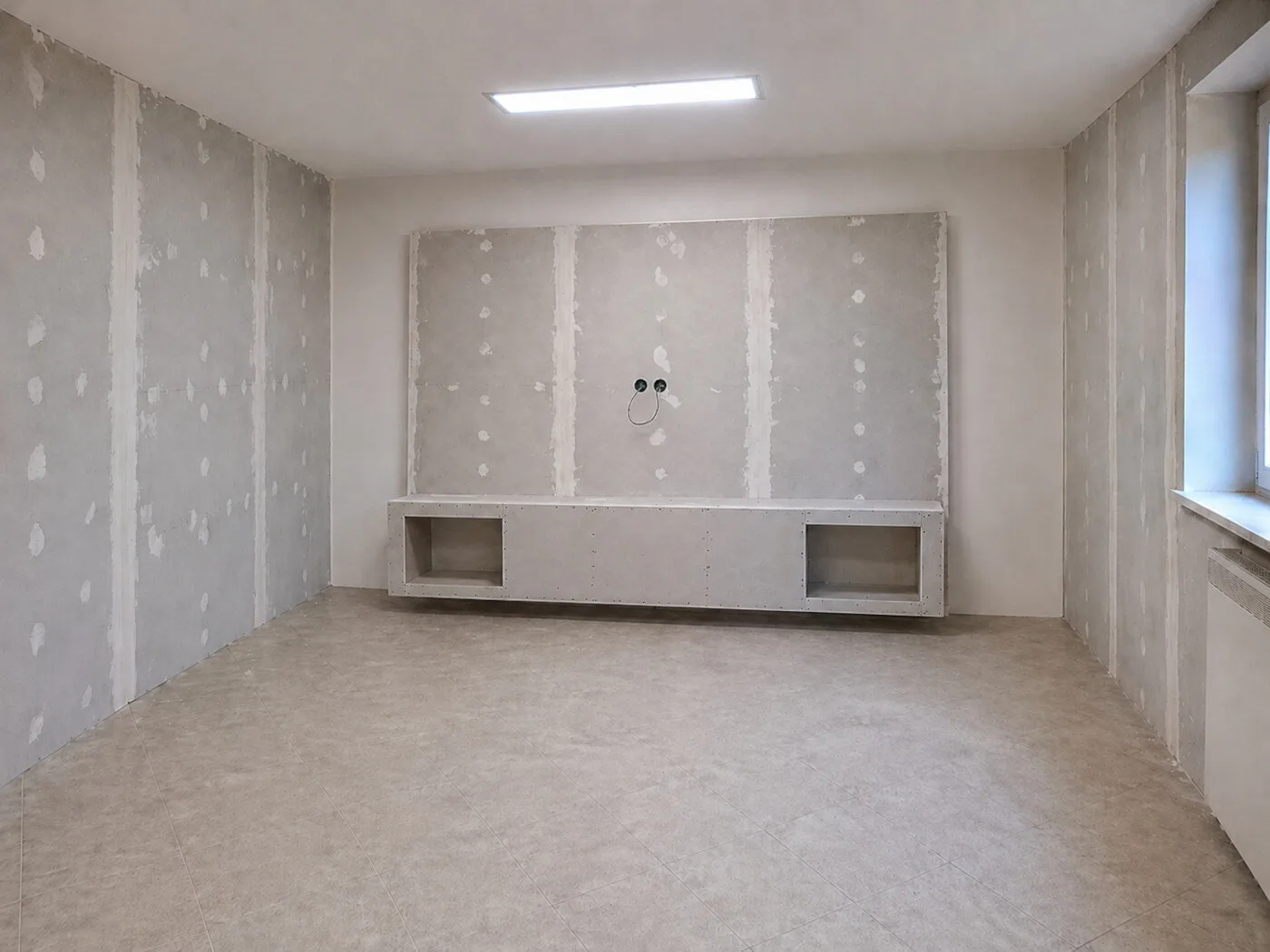
Building the volume and preparing the function
The structure is developed into a full lower built-in unit with niches and preparation for further finishing layers. It is a technical but key stage. This is where not only the look is decided, but also later use, installation routing and the way RTV equipment will be integrated into the whole.
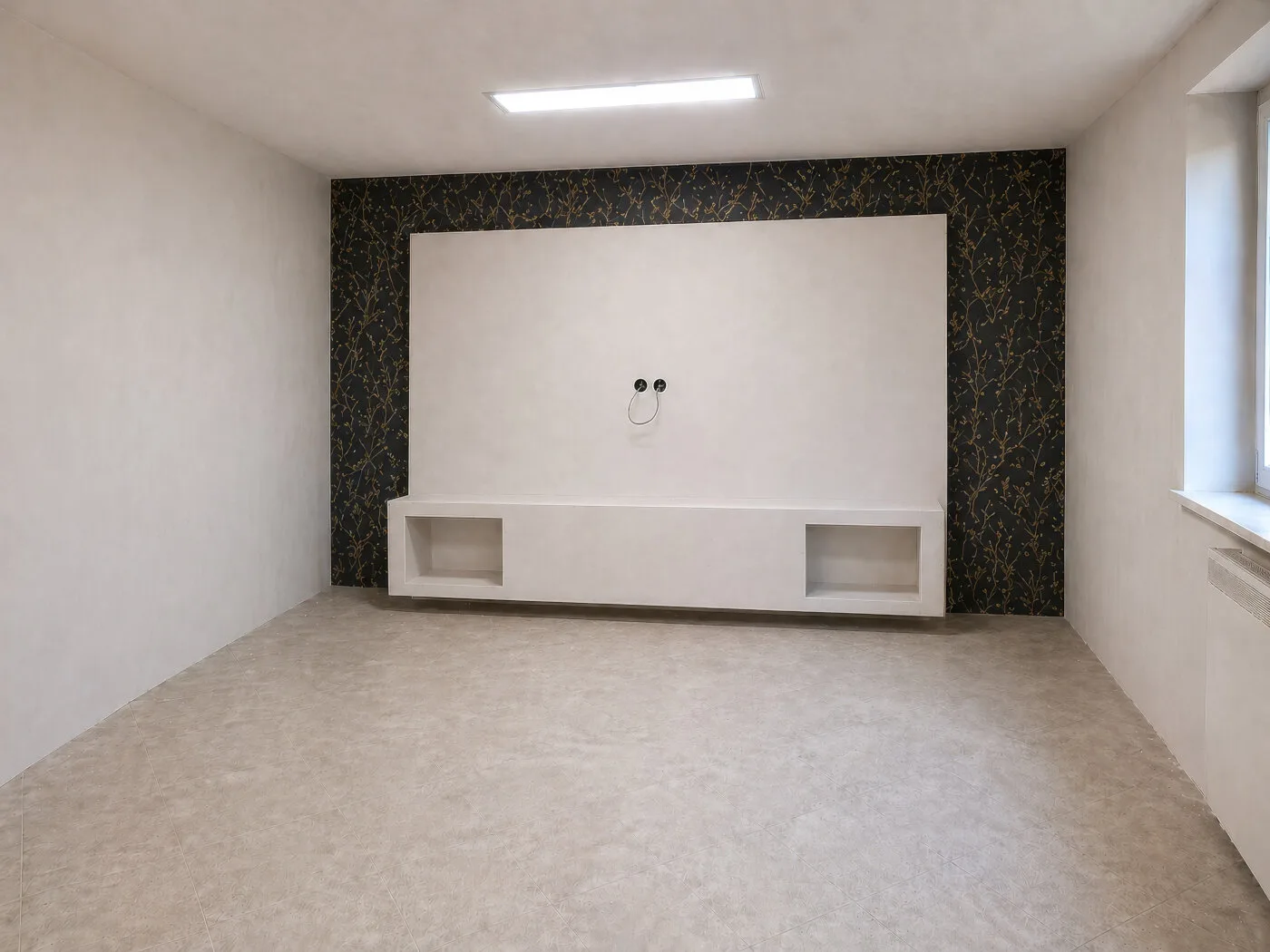
Closing the form and preparing connection points
The built-in volume is now closed and the wall is prepared for further finishing. A TV connection point is ready, the niches are clear and the whole starts to resemble the target layout. It is a transition between construction and aesthetics. The function is already planned, but the interior is still waiting for material, colour and light.
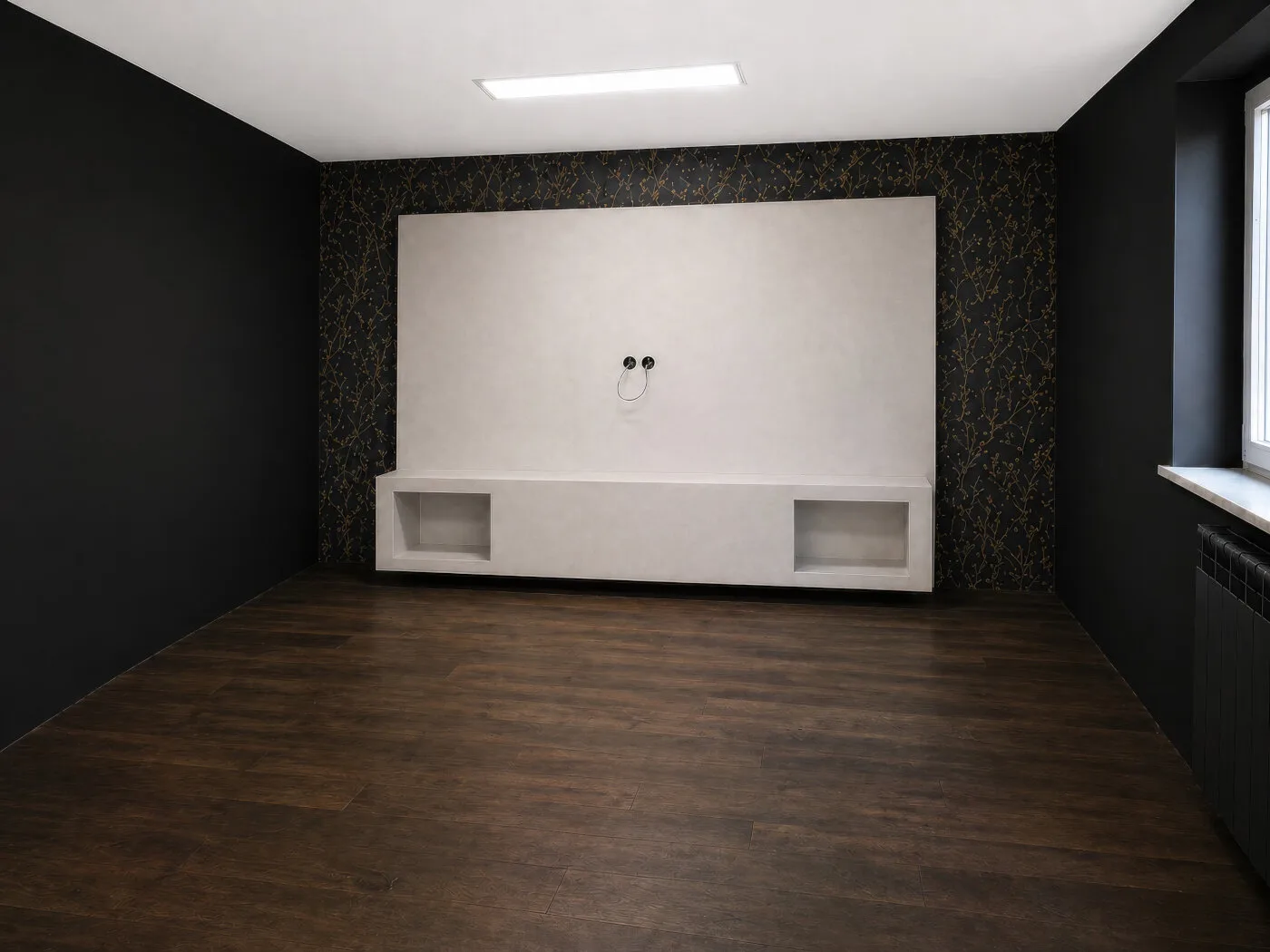
Wall background and the first language of finish
At this stage a decorative background appears and begins to build the depth of the whole composition. The wall behind the built-in stops being neutral and starts working as a deliberate interior element. The built-in itself remains calm and light, but the surroundings give it direction and a more elegant character.
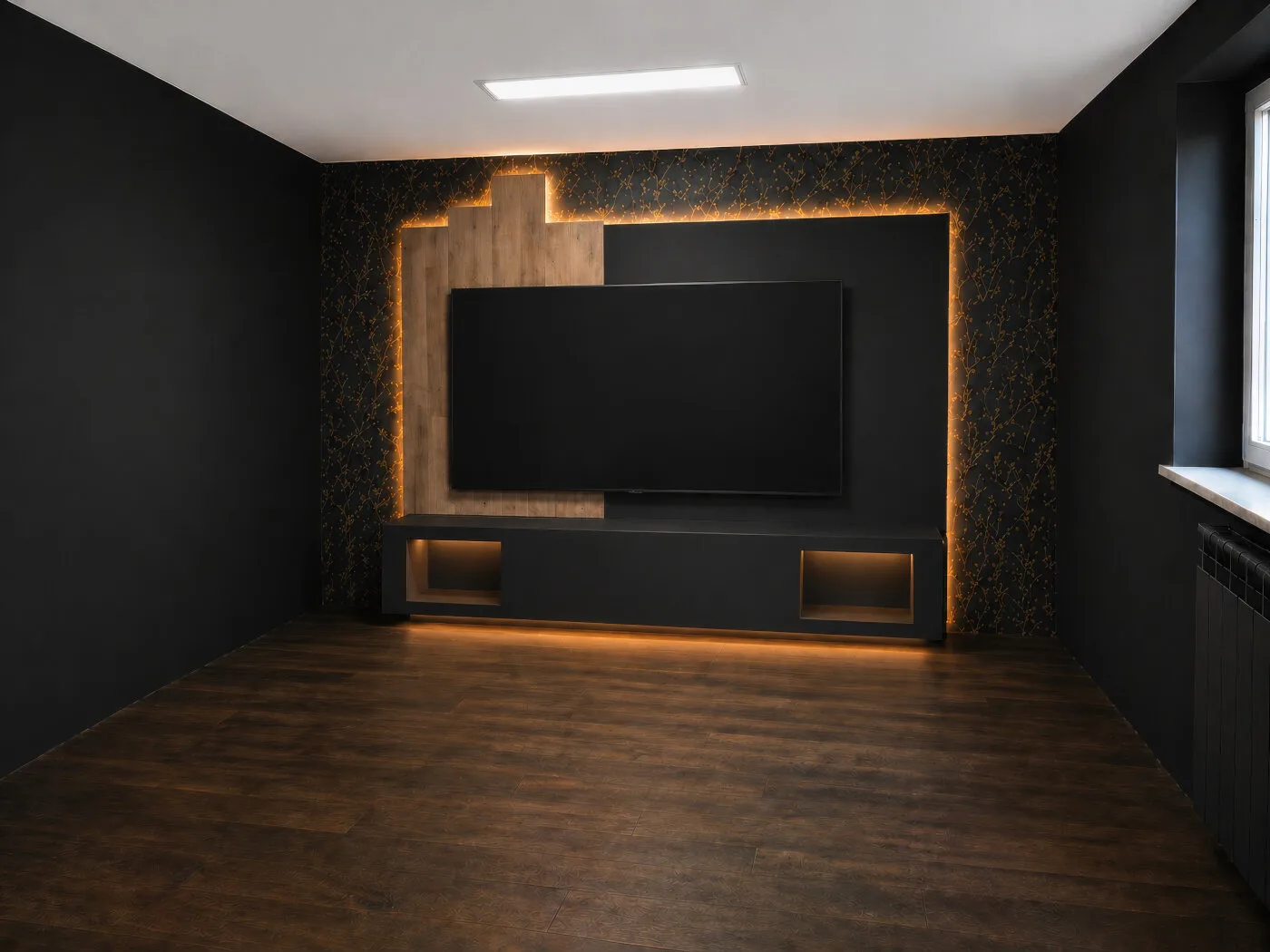
Material contrast and final RTV built-in
Here the design effect becomes clear. Dark colours, a wooden accent, the TV panel, LED lighting and closure of the whole composition appear. An ordinary wall becomes the central element of the interior. This is the stage where a technical built-in starts genuinely building the atmosphere of the living room.
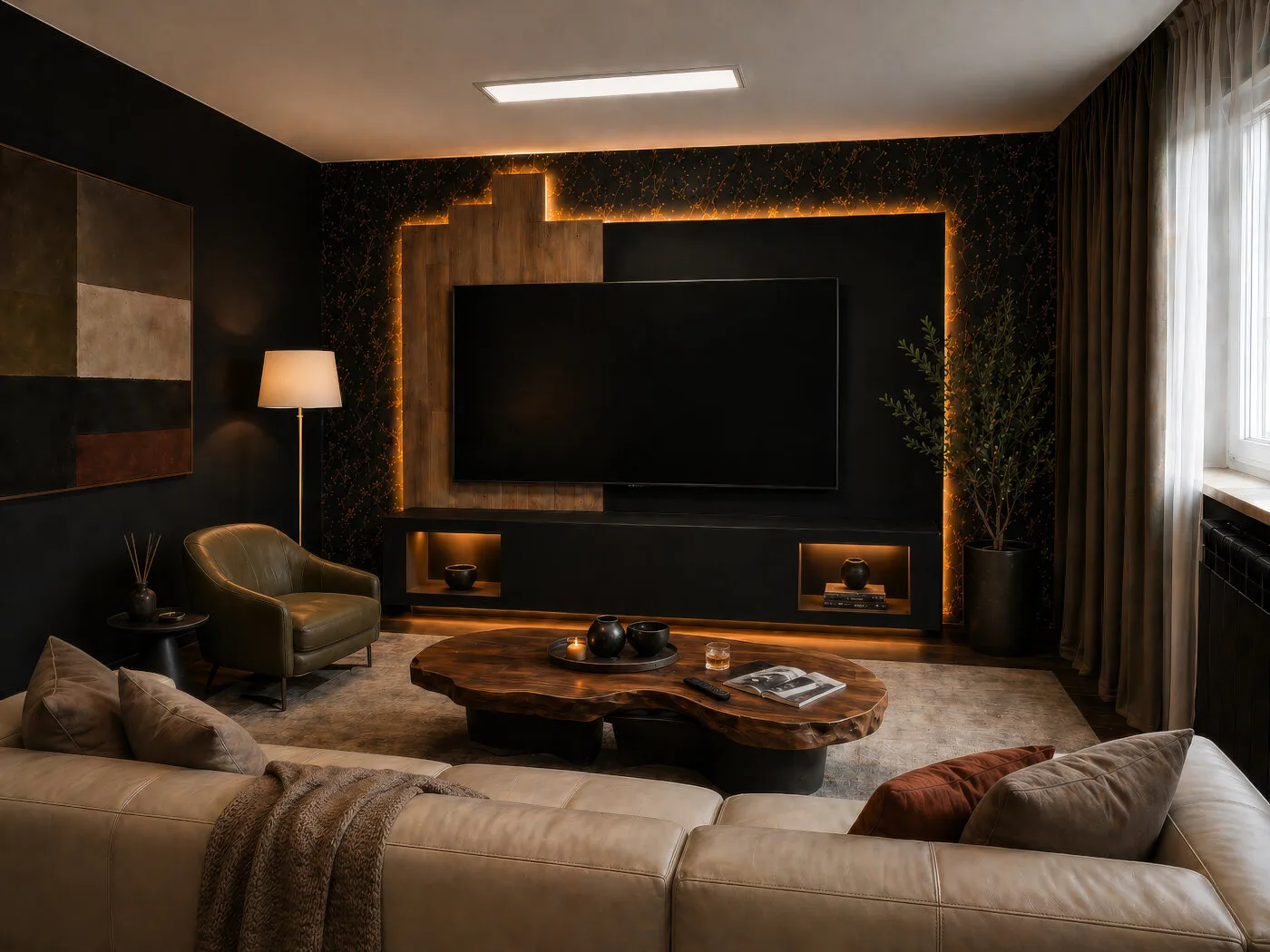
Final closure of the interior
At the end, the arrangement closes the space. Furniture, curtains, a table, decorations and soft light make the built-in stop being only a well-made RTV wall and become part of a complete, refined interior. The final result shows how detail, light and a well-led process can give the whole room class.
Sometimes the best decision starts right here
See what else is worth discovering
Not everyone lands immediately on what they truly need.
That is why we have gathered a few paths that help you look at finishing and renovation from different angles.
Sometimes one right topic is enough for the whole picture to start making sense.
What you gain with us
Peace of mind that lasts
You gain not only a well-finished interior, but also clear rules, real support and the sense that the whole process is handled responsibly from start to finish.
How we can help
Good decisions begin with clear answers
Do you have questions before renovation or finishing? In this section, you will find guidance, calculators and specific answers that help you move forward calmly.
Renovation calculators
Understand the costs before you begin
Quickly estimate the budget for finishing, renovation or an upgrade. No calls, no waiting and no pressure. Just concrete information when you need it.